


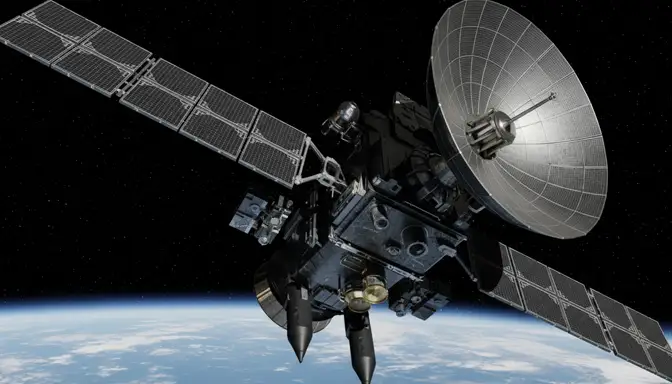
Boeing [NYSE: BA] mission controllers confirmed that the ViaSat-3 F3 (VS-3 F3) satellite is healthy in orbit following its successful launch aboard a SpaceX Falcon Heavy rocket at 10:13 a.m. ET from Kennedy Space Centre (KSC) in Florida. The satellite is intended to expand high-capacity broadband services across the Asia-Pacific region when it enters service.
VS-3 F3 separated from the rocket about five hours after launch. After Boeing’s Mission Control team in El Segundo, California, acquired the satellite’s signal, the team confirmed command capability and started spacecraft initialisation activities.
VS-3 F3 is the third spacecraft launched for the ViaSat-3 program, highlighting Boeing’s repeatable success in producing the most powerful commercial satellite platform, the 702MP+, to support Viasat’s flexible, ultra-high-capacity payload.
“The launch of Viasat-3 F3 marks a major milestone in our partnership with Viasat, said Ryan Reid, president of Boeing Satellite Systems International. “By combining Boeing’s best-in-class satellite platform with Viasat’s innovative payload, we’re delivering the highest capacity communication satellites ever launched. This mission reinforces our commitment to advancing global connectivity.”
VS-3 F3 utilises Boeing’s 702MP+ platform, part of the highly reliable 702 family of satellites, developed for the most demanding payloads. The 702MP+ has enhanced structural, power, thermal and attitude control systems to meet the needs of the VS-3 F3 mission.
“ViaSat 3 F3 is a critical step in expanding a truly global, high-capacity network, and Boeing’s execution brings us closer to delivering seamless connectivity where it matters most for our customers,” said Dave Abrahamian, vice president of Space Systems, Viasat.
Boeing's tailored 702MP+ powers Viasat's flexible payload, which is designed to maximise efficient, flexible bandwidth deployment and provide enhanced performance for commercial mobility, fixed services and defence customers.
Following completion of the spacecraft initialisation activities, Boeing mission controllers will prepare the satellite for orbit raising by deploying the solar arrays produced by Spectrolab, a Boeing subsidiary, and one radiator panel to support the satellite’s electric propulsion. Electric propulsion enables the satellite to reach geostationary orbit with improved fuel efficiency versus a traditional chemical propulsion system, enabling it to meet the required operational lifetime. After geostationary orbit arrival, Boeing will hand over the satellite to Viasat for service entry when both teams complete on-orbit testing.

Prev Article
Airbus acquires of Quarkslab in France
Next Article
WearCheck strengthens onsite sampling capabilities







 Hungary receives two new Gripen fighters
May 2, 2026
Hungary receives two new Gripen fighters
May 2, 2026
 Embraer, TKMS, and the Brazilian Ministry of Defense Sign MoU
May 2, 2026
Embraer, TKMS, and the Brazilian Ministry of Defense Sign MoU
May 2, 2026
 ViaSat-3 F3 Satellite Launches from Kennedy Space Center
May 2, 2026
ViaSat-3 F3 Satellite Launches from Kennedy Space Center
May 2, 2026
 Airbus acquires of Quarkslab in France
April 29, 2026
Airbus leads national industry launch of Spain's CTS
April 29, 2026
Airbus acquires of Quarkslab in France
April 29, 2026
Airbus leads national industry launch of Spain's CTS
April 29, 2026
 25 years of Airbus in Chile: aerospace innovation
April 27, 2026
25 years of Airbus in Chile: aerospace innovation
April 27, 2026
 The UAS trio that could tackle Latin Americas diverse needs
April 27, 2026
The UAS trio that could tackle Latin Americas diverse needs
April 27, 2026
 Boeing, U.S. Navy Achieve Successful MQ-25A Test Flight
April 27, 2026
Boeing, U.S. Navy Achieve Successful MQ-25A Test Flight
April 27, 2026
 Honouring the Visionary Behind Aegis
April 21, 2026
Honouring the Visionary Behind Aegis
April 21, 2026
We identified a significant need for a specialised publication catering to the defence sector.