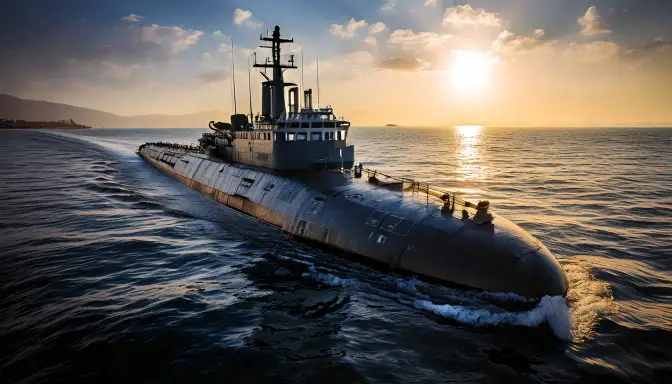


The Japanese Navy has launched its new Taigei-class submarine, the first in this class to use the new Kawasaki 12V 25/31 diesel engines with high output power. At a cost of about $470 million to build, the new 3,000-tonne diesel-electric submarine, named Raigei (thunder whale), entered the water on October 17 in a ceremony held at KHI’s facilities in Kobe City. The submarine is expected to enter service in March 2025.
The first Taigei-class submarine (named Taigei) was commissioned in March 2022. The second of the class, named Hakugei, entered into service in March 2023 while the third of the class (Jingei) is expected to enter service in March 2024. They are a new class of attack submarines developed for the Japan Maritime Self-Defence Force. It is the successor to the SÅryÅ« class.
Raigei, according to the JMSDF, has a crew complement of about 70, an overall length of 84 meters, a beam of 9.1 m, a draught of 10.4 m, and a standard displacement of about 3,000 tonnes. It is just slightly larger than the preceding Soryu-class SSKs, which have a standard displacement of 2 950 tonnes. The Taigei-class submarines are the first Japanese submarine to feature female-only compartments such as a living space for up to six women. The submarine incorporates state-of-the-art equipment such as advanced sonar systems and a snorkel power generation system. Notable features include the X-shaped rudder for improved submerged operations and propulsion performance, as well as advanced acoustic absorbent materials and a floating floor structure for silent underwater operation.
They are equipped with a large number of lithium-ion batteries, as is the case with the eleventh and twelfth submarines of the SÅryÅ« class (ÅŒryÅ« and TÅryÅ«), making it possible for the submersible to travel longer and at higher speeds underwater than conventional diesel-electric submarines. Japan is the only country known to have fitted lithium-ion batteries to replace lead-iron ones. South Korea is expected to follow suit, fitting lithium batteries to the second batch of KSS-III-class submarines.
Diesel engines
The third Taigei-class submarine Jingei, was the last of the class to use two Kawasaki 12V 25/25SB diesel engines main engines. These new diesel engines are compatible with a new snorkel system with enhanced power generation efficiency. Whether this will increase the shaft output of the submarine is still unknown as Raigein currently generates 6,000 horsepower, with a maximum speed underwater of 20 knots.
On-board sensors and radars have been detailed by Naval Technology. “The Taigei-class diesel-electric attack submarine features a high-performance sonar system for enhanced surveillance and detection capabilities. The submarine’s combat management system (CMS) uses information collected from on-board sensors for weapon engagement. The ZPS-6F surface/low-level air search radar fitted in the vessel helps to detect enemy anti-submarine warfare platforms and maritime patrol vessels. The ship is also fitted with a towed array sonar.”
New CMS and snorkel
The class also employs a new combat management system (CMS) combining advanced integrated sensors, command-and-control, and weapon engagement systems. In addition, it adopts an enhanced snorkel system to reduce signatures, and a new-generation sonar system based on fibre-optic array technology to enhance detection capability. The first project developed a new sonar array with improvements in weight reduction, power saving and detection ability in response to improved quietness of future ships and submarines.
Taigei-class SSK weapons
The Taigei class employs the same torpedo counter-measures system that has been incorporated into the last four Soryu-class boats. It is expected to use Japan’s newest torpedo, called the Type 18, succeeding the previous Type 89. The new torpedo will feature improvements in several areas, including propulsion, target detection, and processing.
Armament-wise, the Taigei-class submarines possess a range of capabilities. These ships are equipped with six HU-606 533mm torpedo tubes capable of firing Mitsubishi-built Type 89 heavyweight homing torpedoes in addition to UGM-48 Harpoon anti-ship missiles.
Armed with six HU-606 533mm torpedo tubes capable of launching Mitsubishi-built Type 89 heavyweight homing torpedoes and UGM-84 Harpoon anti-ship missiles, the Taigei-class submarines are well-equipped for both anti-submarine and anti-ship operations. Their armament includes the Type 18 torpedo, a successor to the Type 89 torpedo. They also feature torpedo countermeasures to enhance survivability in hostile situations. The propulsion system consists of a single-shaft diesel-electric setup, powered by two Kawasaki 12V 25/25 SB-type diesel engines and an electric propulsion motor. These advancements in technology make the Taigei-class submarines formidable assets in Japan’s maritime defence strategy.
Other armaments include the Type 18 torpedo and torpedo countermeasures to enhance survivability in times of conflict. These propulsion systems incorporate a single-shade diesel-electric setup which is powered by two Kawasaki 12V 25/25 SB-type diesel engines in addition to an electric propulsion motor.
The class is also capable of deploying the UGM-84L Harpoon Block II anti-ship missile against surface targets. This missile range is 248 km – enough to provide Japan with a “counterattack” capability.
Development
Further research called for the next-generation submarine to make use of a floating floor structure; the floorboards are attached to the inner shell through a buffer mechanism to prevent vibration inside the submarine from getting out into the water where it might be detected. A secondary purpose of the buffer research was to protect and mitigate against shock delivered from outside coming into the submarine.
Notable features include the X-shaped rudder for improved submerged operations and propulsion performance, as well as advanced acoustic absorbent materials and a floating floor structure for silent underwater operation. The pressure hull is constructed from high-strength steel, ensuring resilience under high water pressure during deep-sea missions.
Increasing defence
Japan is building up its defence force as the threat of a possible China vs Taiwan conflict and the attempt by North Korea to develop nuclear weapons is a constant concern for the island nation. The JMSDG is rated as one of the largest naval fleets behind China and the U.S.
In 2022 the Japan Maritime Self-Defence Force commissioned JS Kumano, the first of its new Mogami-class multi-role frigates. The warship is the first of a planned class of 22 ships that are destined to replace the fleet’s ageing Abukuma-class destroyer escorts and Asagiri-class light destroyers.