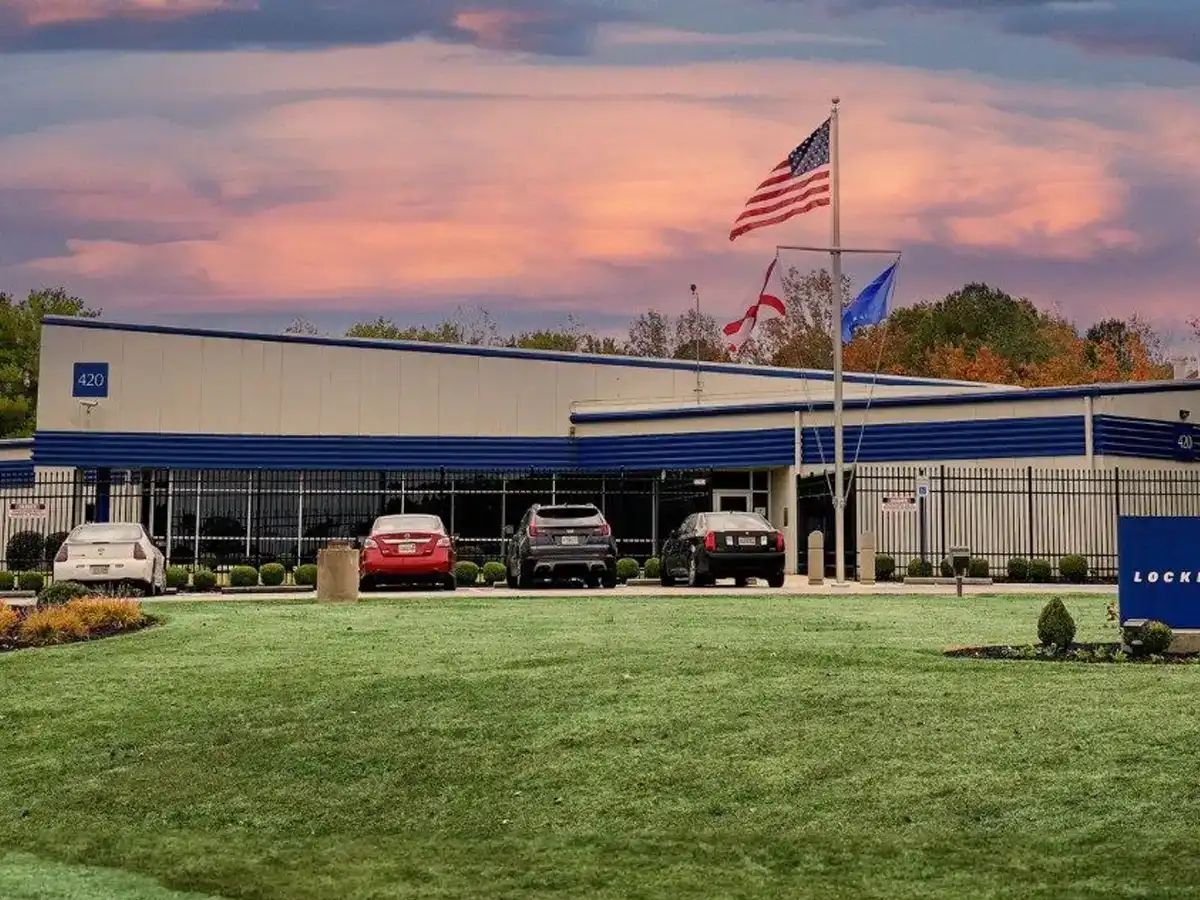
Lockheed Martin is transforming a site that once trained pilots during World War II into a modern facility that meets the national security needs of today.
The 88,000-square-foot Missile Assembly Building (MAB-5) in Courtland, Alabama, opened in June 2026 to support further developments of the Next Generation Interceptor (NGI) program. Representing another Lockheed Martin-funded capital investment in the Lawrence County community, the expansion sits on the site of the original Courtland Army Airfield.
A History Lesson
Activated in 1942 as a Basic Flying School for Air Cadets, the airfield was constructed at an unprecedented pace to meet the wartime demand of training upwards of 100,000 new aviators per year. The small campus was comprised of four interlocking concrete runways, various barracks and hangars, a hospital, a chapel and even a library. Housing more than 4,000 enlisted personnel, it became the largest population centre in Lawrence County during the war.
The historical marker for the Courtland Army Air Field, which sits just outside the Lockheed Martin campus in Courtland, Alabama.
The site faced several revamps over the decades. After deactivation in 1945, the property was turned over to the State of Alabama, and most of the original buildings were removed. In the 1980s, Lawrence County transformed the space into an industrial park and airport.
In 1994, Courtland returned to the forefront of national security when Lockheed Martin constructed nine buildings on the 660-acre campus. Over the last three decades, the site has evolved into a fully integrated defence manufacturing hub, capped by the opening of MAB-4 in 2021, a digital-first facility supporting hypersonic systems production.
21st Century Security
Today, MAB-5 represents a milestone not only for Lockheed Martin’s presence in North Alabama but also for the whole nation’s missile defence architecture, as space takes the stage as the first line of defence against emerging threats.
NGI will be assembled and integrated at MAB-5, leveraging a full suite of digital engineering and advanced manufacturing tools that define Lockheed Martin’s 21st-century approach. Digital models guide every step of assembly, allowing engineers to simulate system performance before physical production begins, while smart manufacturing practices like robotic assembly, precision tooling and automated alignment ensure reliability and speed.
NGI is designed to defend the homeland against the most advanced long-range missile threats, delivering the speed and accuracy warfighters need to outpace adversaries. By equipping them with a highly reliable system capable of eliminating multiple targets at once, NGI strengthens deterrence and secures the homeland for future generations. Building NGI at MAB-5 not only strengthens the first line of defence in space but also cements North Alabama as the epicentre of advanced aerospace manufacturing and critical technology development.
On the same ground where young pilots once earned their wings, Lockheed Martin will now lead the charge in building systems that empower America’s warfighters and shape the future of global security.