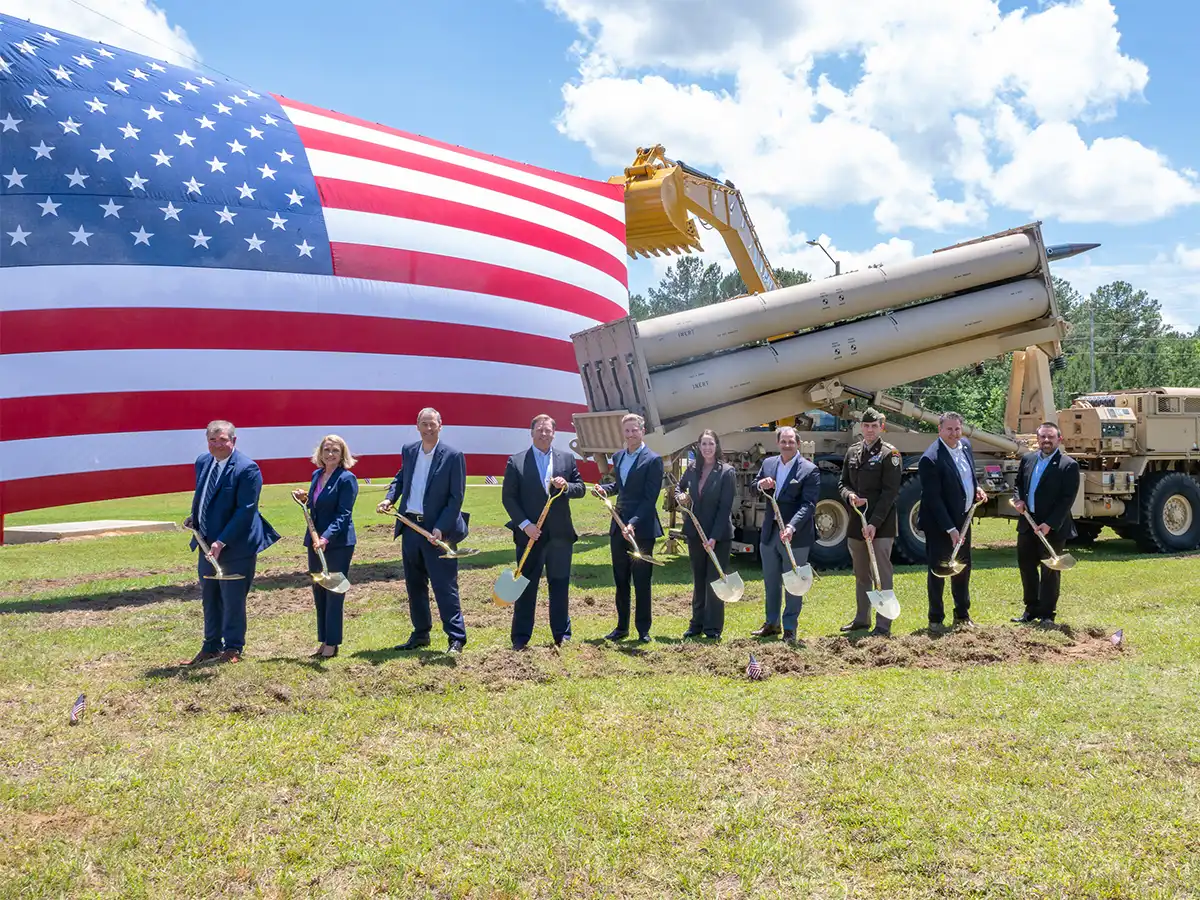
Lockheed Martin broke ground on a new Munitions Production Center in Troy, Alabama, marking its latest investment to expand munitions production for the United States and its allies. Building forty-seven will add 87,000 square feet of production space to support Terminal High Altitude Area Defense (THAAD) interceptors and future work on the Next Generation Interceptor (NGI). Lockheed Martin's more than $9 billion investment through 2030 is already delivering tangible results to meet heightened munitions demand, including this new facility and more than twenty others across the United States.
The expansion will nearly double the facility's current production space and is expected to create a considerable number of new American jobs over the next three years, adding to Lockheed Martin's 4,000 employees in Alabama.
EXPERT PERSPECTIVE
“This partnership is critical to surging our munitions capacity, and Lockheed Martin has leaned in aggressively. Today is a testament to that partnership and that progress,” said the Honourable Michael Duffey, Under Secretary of Defense for Acquisition and Sustainment, during the groundbreaking ceremony.
“Lockheed Martin is ready now to meet the urgent demand to expand production capacity,” said Lockheed Martin Chairman, President and CEO Jim Taiclet. “We have already invested well over a billion dollars in this expansion, which directly strengthens deterrence and helps ensure our service members and allies have the capabilities they need, when they need them.”
WHY IT MATTERS
In addition to the United States, THAAD is operated by the United Arab Emirates and the Kingdom of Saudi Arabia. It is the only U.S. system designed to intercept targets both inside and outside the atmosphere, and it is integrated with PAC-3® Missile Segment Enhancement (MSE) to provide warfighters with an expanded battlespace and greater flexibility.
ADDITIONAL CONTEXT
Future Growth in Alabama: Lockheed Martin is planning several additional facility groundbreakings and expansions in the state to support other programs, including the Next Generation Interceptor (NGI), AGM-158, and the Air-Launched Rapid Response Weapon (ARRW).
Alabama Community Support: Lockheed Martin is strengthening Alabama communities through investments in military and veteran support, STEM education, and community resilience. In 2025, the company awarded more than $640,000 in grants to eighteen nonprofit partners statewide and invested $200,000 in the STEM Academy Lab at the Center for Advanced Academics and Accelerated Learning in Pike County Schools, supporting hands-on student learning with advanced tools and technologies.
Multibillion-Dollar Investment: Lockheed Martin is investing more than $9 billion through 2030 and is already using that funding to scale munitions production and upgrade or build more than twenty facilities across the United States to meet heightened defence demand.
Supply Chain Resilience: Lockheed Martin is strengthening the resilience of its supply chain, deepening collaboration with suppliers and driving innovation across its operations. Last week, the company hosted a summit with suppliers critical to scaling munitions production, with a focus on building stronger relationships, increasing speed and advancing solutions to prepare for current and future threats.
Acquisition Transformation Strategy: Lockheed Martin was the first in the industry to announce a framework agreement for munitions acceleration under the Department of Defence’s Acquisition Transformation Strategy, tripling production capacity for the combat-proven PAC-3 MSE interceptor. Following that agreement, Lockheed Martin announced additional agreements to quadruple production of THAAD and the Precision Strike Missile (PrSM).
Manufacturing Details: Lockheed Martin has more than 340,000 square feet of dedicated THAAD operations space across nine U.S. sites, supported by 750 U.S.-based suppliers in forty-two states.