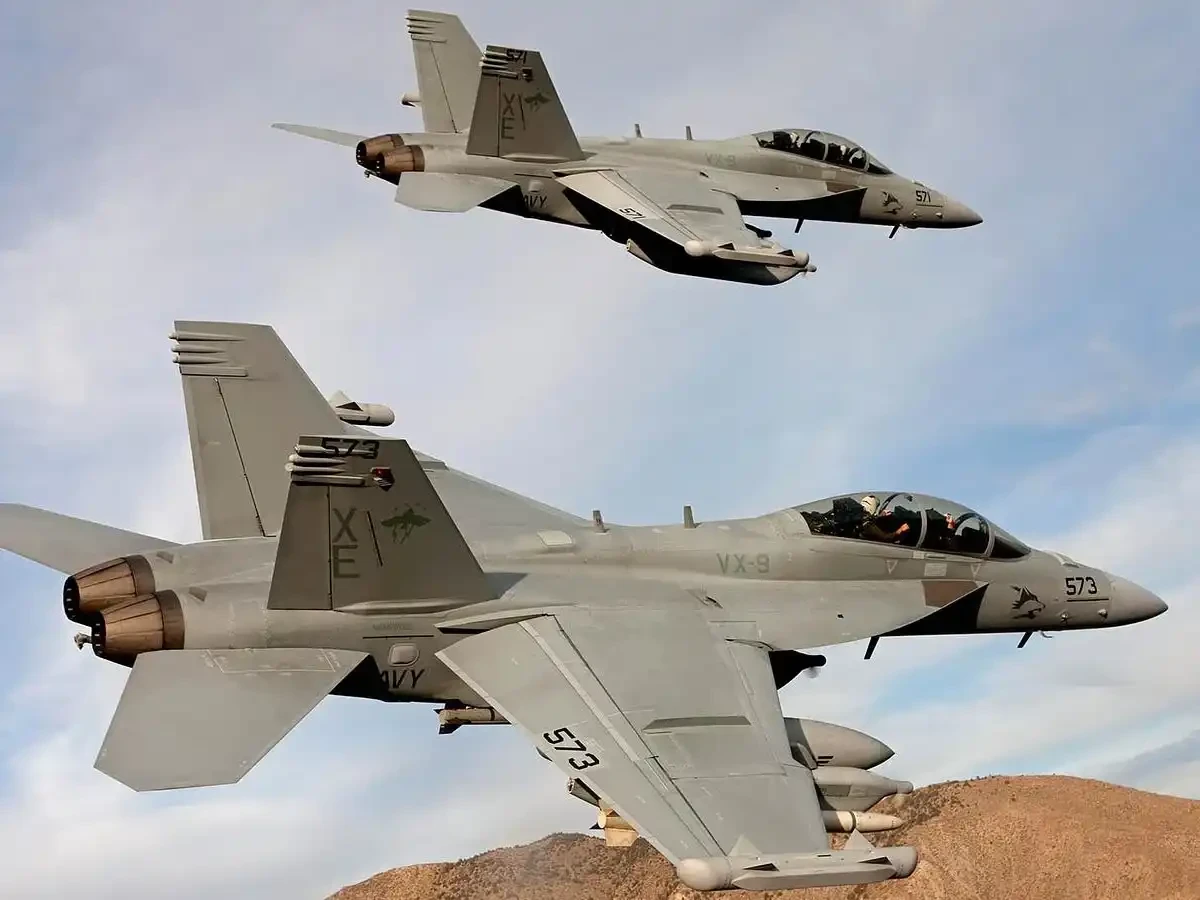
On Aug. 15, 2006, the first EA-18G Growler — known as EA-1 — made its maiden flight from Lambert International Airport in St. Louis, Missouri, with Boeing test pilot Ricardo Traven and chief weapons system operator Rick Junkin at the controls. Two decades later, Traven remembers that historic moment.
“From the first flight that I had the pleasure to pilot with my WSO Rick Junkin, it was obvious to us what a terrific capability and future this aircraft would blaze in the years that followed,” Traven said.
The Growler was developed to replace the Northrop Grumman EA-6B Prowler and marked a major step forward in airborne electronic attack capability. For former U.S. Navy EA-18G Growler pilot Paul “Disco” Ritter, the difference was striking.
“I started my career flying the EA-6B Prowler,” Ritter said. “It was an amazing machine — it was fun, like flying a farm truck. Transitioning to the Growler was like upgrading to a Ferrari.”
Today, 20 years after that first flight, the Growler remains the U.S. Navy’s premier airborne electronic attack aircraft — and its capabilities continue to advance.
Former U.S. Navy EA-18G Growler pilot Paul “Disco” Ritter flew the Growler for 15 years and logged more than 2,300 flight-hours in the aircraft. (Photo courtesy of Paul Ritter)
Crafting an electronic warrior
Development of the EA-18G Growler began in December of 2003 when Boeing signed a five-year System Development and Demonstration contract with the U.S. Navy, marking the official start of the program.
At the time, the Navy’s EA-6B Prowler had served for decades, but it was becoming increasingly outdated. The Navy needed a new aircraft capable of performing the full spectrum of electronic warfare missions, including surveillance, jamming, and suppression of enemy air defences, while also improving reliability, maintainability, and operational flexibility. These requirements gave birth to the EA-18G Growler.
The aircraft was officially designated the “Growler” on Nov. 8, 2005. The name “Growler” has historical significance in the U.S. Navy, having been used for various vessels and submarines since the War of 1812, reflecting a tradition of naming electronic attack platforms with this moniker.
Blocking enemy eyes and signals
The EA-18G Growler’s primary role is to jam radars and communications signals of threat forces, disabling their ability to detect and track U.S. and allied military forces. Built as a variant of the F/A-18 Super Hornet, the Growler is a carrier-capable fighter that can carry a range of jamming pods, weapons and other stores. It can execute multiple mission sets, including stand-off jamming and escort jamming.
Key milestones
Since first flight, the Growler has achieved several major milestones:
Sept. 22, 2006: The first EA-18G Growler was delivered to the Naval Air Test Centre at Patuxent River, Maryland.
May 16, 2008: Boeing opened a new EA-18G Growler Support Centre at Naval Air Station Whidbey Island, Washington, in preparation for the delivery of the first EA-18G Growler to the U.S. Navy fleet.
June 4, 2008: Boeing delivered the 1st fleet EA-18G Growler to the U.S. Navy’s Electronic Attack Squadron (VAQ) 129 ahead of schedule and within budget.
July 12, 2011: Boeing EA-18G Growlers operated by U.S. Navy electronic attack squadron VAQ-132 safely returned home to their base at Naval Air Station Whidbey Island, Washington, after completing their first combat deployment.
May 5, 2014: Boeing delivered the 100th EA-18G Growler to the U.S. Navy.
July 29, 2015: Boeing unveiled the first Royal Australian Air Force Growler. Australia becomes the first nation outside the United States to fly the airborne electronic attack platform.
March 19, 2021: Boeing inducted the first EA-18G Growler into the Modification Program. The inducted aircraft receive upgrades that will enable Next Generation Jamming compatibility.
Real-world impact
The Growler has been a key component in protecting and defending American and allied forces during its 20 years of service. Recently, the Growler has played key roles in jamming enemy air defences and enabling U.S. and allied operations in the Red Sea, Venezuela, and various parts of the Middle East.
Paul “Disco” Ritter, who flew the Growler for 15 years and logged more than 2,300 flight-hours in the aircraft, saw its impact firsthand.
“The Growler provides added layers of protection for the entire air wing by gathering information on threats not seen in real time and provides that target data, threat warning, and protection to other aircraft like the F/A-18 or the F-35,” Ritter said. “No other military aircraft does what it does, and it has changed how the air wing operates and performs strikes.
“The range of the threats our military faces today has increased tremendously, and the layered electromagnetic effects the Growler provides reduces the capability of those threats we face,” Ritter said. “The Growler gives our air wing a clear advantage in the fight.”
Growlers are equipped with the latest electronic warfare technology, which includes Next Generation Jamming pods, communication countermeasures and joint tactical satellite communications.
Flying into the future
Through the Growler Modification Program, aircraft will receive upgrades to their processing power, detection capabilities, and ability to employ the Next Generation Jamming pods. In addition, Boeing teams continue to design and develop enhanced capabilities as part of the Growler Block II capability suite to ensure the EA-18G remains poised to deny, degrade and dominate the electromagnetic battlespace, keeping warfighters ahead of the fight and protecting U.S. and allied forces for years to come.